.png?width=165&height=66&name=Untitled%20design%20(9).png "Untitled design (9)")

One door closed. Here is every door still open, read from the actual law.
A new law passed Parliament and within days the headlines decided what it meant. "SMSF property is dead." "The super property door just slammed shut." If you hold property in your fund, or you were planning to, that is an unsettling thing to read on a Tuesday.
So I did what I always do when the noise gets loud. I went and read the actual words of the legislation, then the existing rules they sit on top of, and worked out, from first principles, what genuinely changed and what did not. This edition is that work. Not a summary of someone else's carousel. The text itself, and what it means for someone deciding how to put super to work in property.
The short version: one specific door closed. It is a meaningful one, but it is one. Most of what people are mourning was never touched. And the question worth your time is not "is it over," it is the one in the title: how can I actually invest in Australian property through my SMSF now?
A note before we start. This is my reading of the law for my own decisions, written down. It is general information, not financial, tax, or legal advice. SMSF structuring is genuinely technical and the cost of getting it wrong is high, so anything here is a starting point for a conversation with your own SMSF specialist, accountant, and lawyer, not a substitute for one. The full disclaimer is at the bottom and it means what it says.
1. What the bill actually changed
The instrument is the Treasury Laws Amendment (Tax Reform No. 1) Act 2026. It runs to five schedules and reshapes a lot of property tax for individuals. For super, it changes exactly one thing.
It amends the borrowing rules. A super fund generally cannot borrow at all. The one long-standing exception is the limited recourse borrowing arrangement, or LRBA.
An LRBA is the only way a super fund is allowed to borrow. The fund takes a loan to buy a single asset, that asset is held in a separate holding trust until the loan is repaid, and if the fund defaults the lender can claim that one asset and nothing else. The rest of your super is ring-fenced from the loan. That ring-fence is the "limited recourse," and it is the whole reason borrowing inside super was ever possible. The bill adds a condition to that exception.
What the law says · [New, the Bill] Treasury Laws Amendment (Tax Reform No. 1) Act 2026, Schedule 5, amending SIS Act 1993 s 67A(2)
"; and (c) for an asset that is real property—the asset is business real property (within the meaning of section 66 of this Act)."
Read that carefully, because everything follows from it. Under a borrowing arrangement, real property now has to be business real property. Residential does not qualify. So:
- Borrowing inside super to buy residential property is gone for new arrangements.
- Borrowing inside super to buy commercial property is untouched.
- Anything that does not involve the fund borrowing is untouched entirely.
The timing and the protection for existing deals are spelled out too.
What the law says · [New, the Bill] Schedule 5, commencement and application
Commencement: "The 45th day after this Act receives the Royal Assent." Application: the change does not apply "to the extent that... the acquisition of the asset (to which the borrowing under the arrangement relates) happens under an arrangement entered into before that commencement."
So the ban bites roughly six weeks after the Act receives assent, which on the current timetable points to around mid-August 2026. Existing arrangements are grandfathered, and the trigger is the contract date, not settlement. A residential contract exchanged before commencement is protected even if it settles later.
That is the whole change to super. One condition, on one structure.
The part the headlines skipped
Two other parts of the same Act quietly make super more attractive for property, not less, relative to owning in your own name.
First, negative gearing. The Act quarantines rental losses on established residential property for individuals from the 2027 to 2028 year. Complying super funds are carved out.
What the law says · [New, the Bill] Schedule 2, ITAA 1997 s 26-155(4)
"Subsection (1) does not apply to you if you are: (a) a widely held unit trust... or (b) a complying superannuation entity."
Second, capital gains tax. The Act removes the 50% CGT discount for individuals on established property and replaces it with indexation plus a 30% minimum rate. Complying super funds keep their existing one-third discount. With fund earnings taxed at 15%, that one-third discount produces an effective rate of about 10% on a gain held longer than a year, and zero in pension phase.
Put those together. From 1 July 2027, an individual investor loses the 50% discount and, on established stock bought after 12 May 2026, loses negative gearing. A super fund keeps the one-third discount, and it sits outside the negative-gearing limit as well. Be precise on that second point, though: a fund's losses only offset income inside the fund, never your personal salary, so it is not negative gearing in the personal sense. The real edge is the capital gains treatment. Either way, the gap between owning established property in your own name and owning it in super just widened. That is the real story under the panic, and it is why understanding the structures below matters more now, not less.
2. The two questions that decide everything
Almost every confused conversation about SMSF property, and almost every misleading post, comes from merging two completely separate questions. Hold them apart and the whole thing becomes navigable.
Axis 1, your buying strategy. What are you holding, and how are you funding it? Residential or commercial. Cash or borrowing. Held directly, through a unit trust, or through a fund.
Axis 2, your related-party dealings. Who are you buying the asset from, and who are you leasing it to? Yourself and your relatives, or unrelated parties.
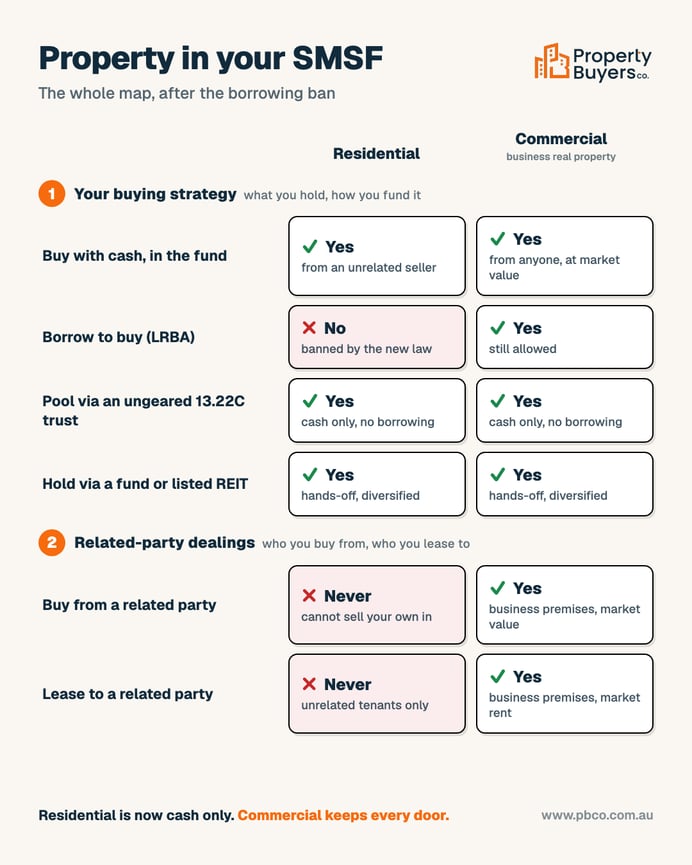
These two axes do not depend on each other. You can get Axis 1 right and Axis 2 wrong, and the fund is in trouble. The carousels blur them constantly, usually by drawing the one marketable combination and implying it is the only one. Here is the whole map on a single grid.
| Residential | Commercial (business real property) | |
|---|---|---|
| Buy with cash, held in the fund | Yes, from an unrelated seller | Yes, from anyone including yourself, at market value |
| Buy with borrowing (LRBA) | No, banned by the new law | Yes, still allowed |
| Hold via an ungeared 13.22C unit trust | Yes, cash only | Yes, cash only |
| Hold via a fund or listed REIT | Yes | Yes |
| Acquire from a related party (sell your own in) | No, never | Yes, if business real property, at market value |
| Lease to a related party | No, never | Yes, if business real property, market rent, written lease |
The top four rows are Axis 1. The bottom two rows are Axis 2. Notice what each axis is doing. Axis 1 is where the new law lives, and it only struck one cell: residential plus borrowing. Axis 2 was not touched by the bill at all. It is old, settled law, and it is where most of the genuine traps sit.
Two rules run underneath both axes and override everything else. They are worth meeting before the structures, because they are the reason the structures have the shape they do.
What the law says · [Existing law] SIS Act 1993 s 62(1), the sole purpose test
"Each trustee of a regulated superannuation fund must ensure that the fund is maintained solely: (a) for one or more of the following purposes (the core purposes): (i) the provision of benefits for each member of the fund on or after the member's retirement..."
Solely for retirement benefits. Not to house your kids, not to give your business a cheap deal, not for any present-day perk. That is the spine.
What the law says · [Existing law] ITAA 1997 s 295-550(1), non-arm's length income
"An amount of ordinary income or statutory income is non-arm's length income of a complying superannuation fund... if, as a result of a scheme the parties to which were not dealing with each other at arm's length in relation to the scheme: (a) the amount of the income is more than the amount that the entity might have been expected to derive if those parties had been dealing with each other at arm's length..."
This is the enforcement mechanism. Deal with yourself on non-commercial terms and the income, and the capital gain when you sell, is taxed at 45% rather than 15%. It taints the asset, it is hard to undo, and it is where the ATO spends its attention. Every structure below survives or dies on these two rules.
3. Axis 1: your buying strategy
Cash versus borrowing
This is the cell the new law changed, so be precise about it.
Borrowing inside super only ever worked through one structure, the limited recourse borrowing arrangement. It is deliberately narrow.
What the law says · [Existing law] SIS Act 1993 s 67A(1)
The exception applies to a borrowing under an arrangement where "the money is or has been applied for the acquisition of a single acquirable asset," the asset "is held on trust so that the RSF trustee acquires a beneficial interest," and "the rights of the lender or any other person against the RSF trustee for... default... are limited to rights relating to the acquirable asset."
One asset, held in a separate holding trust, and the lender can only ever come after that one asset, not the rest of your super. That last feature, limited recourse, is the whole point of the structure. The new law leaves all of that in place and adds a single filter on top: if the asset is real property, it must be business real property. Commercial passes. Residential does not.
So from commencement, the buying strategy splits cleanly. If you want to borrow, you are buying commercial. If you want residential, you are paying cash, one way or another. Residential in super is now an unleveraged game. That is the real consequence of the ban, and it is a serious one, because gearing was the entire reason most people put residential into super in the first place.
Held directly, via a trust, or via a fund
Cash itself has three shapes, and they matter for pooling and for who can co-invest. The fund can buy the property directly in its own name. It can co-invest with related parties through an ungeared unit trust. Or it can buy units in a fund or a listed REIT. We will work through each in the structures below.
4. Axis 2: who you buy from, who you lease to
This axis is entirely about related parties, meaning you, your relatives, and entities you control. The general rule is a flat prohibition.
What the law says · [Existing law] SIS Act 1993 s 66(1)
"Subject to subsection (2), a trustee or an investment manager of a regulated superannuation fund must not intentionally acquire an asset from a related party of the fund."
You cannot sell your own asset into your fund. There is one exception that matters for property.
What the law says · [Existing law] SIS Act 1993 s 66(2)(b)
The prohibition does not apply if "the fund is a superannuation fund with no more than 6 members—the asset is business real property of the related party acquired at market value."
Business premises only. You can move your own commercial premises into your fund at market value. You cannot move your own residential rental in. There is no residential equivalent of this exception, and that is a permanent feature, not part of the new bill.
Now the definition that does the heavy lifting, because it is the single most misrepresented point in the whole topic.
What the law says · [Existing law] SIS Act 1993 s 66(5), definition of business real property
"...any freehold or leasehold interest... in real property... where the real property is used wholly and exclusively in one or more businesses (whether carried on by the entity or not), but does not include any interest held in the capacity of beneficiary of a trust estate."
Read the words in the brackets: "whether carried on by the entity or not." The business that uses the property does not have to be yours. A commercial property leased to any arm's length business tenant is business real property. This is the point the popular diagrams get wrong. They draw commercial-in-super as "lease it to your own company," as if that is the rule. It is one option, not the rule. The law is broader, and the difference is not academic, as we will see.
Leasing to a related party is governed by the in-house asset rules, and business real property gets its own carve-out there too.
What the law says · [Existing law] SIS Act 1993 s 71(1)(g)
An in-house asset does not include, "if the superannuation fund has no more than 6 members—real property subject to a lease... between a trustee of the fund and a related party of the fund, if, throughout the term of the lease..., the property is business real property of the fund."
So commercial premises can be leased to your own business without tripping the 5% in-house asset cap, provided it stays business real property and the rent is at market. Residential leased to a related party gets no such exception and is simply prohibited in practice.
The clean summary of Axis 2: you can buy commercial from yourself and lease commercial to yourself, at arm's length terms. You can do neither with residential. Residential in super is always bought from a stranger and leased to a stranger.
5. The structures, commercial
Commercial is the flexible side of the map. Every door is open, including borrowing.
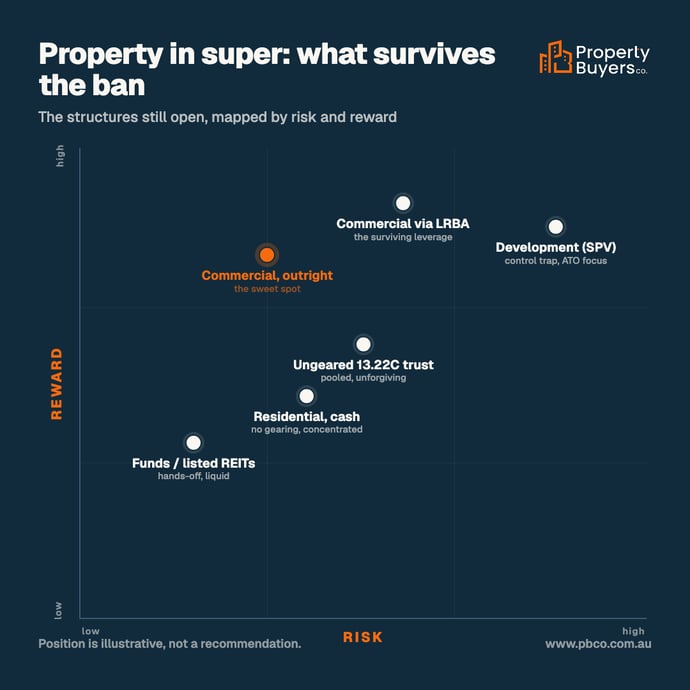
Outright purchase. The fund buys the premises with cash. It can buy from an unrelated seller, or from you at market value if it is business real property. It can lease to an unrelated tenant, or to your own business at market rent. Rent is taxed at 15% in the fund, zero in pension phase, and the gain on sale carries the one-third discount.
Via an LRBA. The surviving borrowing path. The fund puts in a deposit, borrows the rest under the limited recourse structure, and buys a commercial property. This is the only way to gear property inside super now.
Lease to your business, or to a stranger. Both are allowed, and this is where the validated point earns its keep. Leasing to your own business is the marquee play for an owner-operator: the rent leaves your trading company, lands in your super taxed at 15%, and the premises sit outside your business balance sheet. But if you do not own a business, the structure is not closed to you. You buy a commercial property and lease it to an arm's length tenant, exactly as you would any investment property. The tenant's business satisfies the "wholly and exclusively in a business" test.
| Commercial option | How you fund it | Lease to | Strength | Limitation |
|---|---|---|---|---|
| Outright, lease to your business | Cash | Related party (market rent) | Rent into super at 15%, premises off your business balance sheet | Needs a business and the cash; NALI risk if rent is not market |
| Outright, lease to a tenant | Cash | Unrelated | Simple, no related-party rules in play | Vacancy and concentration risk in one asset |
| Via LRBA | Deposit plus borrowing | Either | Gears the rental income and growth; the only leverage left in super | Compliance load, finance cost, NALI risk |
The watch-out across all three is the same. Market rent, a written lease, and arm's length terms, every time, or s 295-550 turns the income and the eventual gain into 45% income.
6. The structures, residential
Residential is the side the new law narrowed. The headline "you can no longer hold residential in super" is wrong. What you can no longer do is borrow to hold it. Cash residential is alive, in three forms.
Outright purchase, directly in the fund. The fund buys a residential property with its own cash, from an unrelated seller, and leases it to an unrelated tenant. No borrowing, no related-party dealing. This is the simplest residential path and it survives the bill completely. The constraint is capital. With no leverage, the fund buys what its cash can buy, and one property can swallow most of a mid-sized balance.
Pooled, via an ungeared unit trust. This is the structure people reach for when one fund cannot afford the property alone, or when they want to co-invest with a family trust. It relies on Regulation 13.22C, which lets the fund hold units in a related trust without those units counting as in-house assets, as long as the trust stays inside a tight box.
What the law says · [Existing law] SIS Regulations 1994, reg 13.22C(2)
The units are not an in-house asset if, when acquired: "(a) the superannuation fund has no more than 6 members; and... (e) the company, or a trustee of the unit trust, does not have outstanding borrowings; and (f) the assets of the company or unit trust do not include: (i) an interest in another entity; or (ii) a loan to another entity, unless the loan is a deposit with an authorised deposit-taking institution...; or (iii) an asset over, or in relation to, which there is a charge; or (iv) an asset that was acquired from a related party... after 11 August 1999, unless the asset was business real property acquired at market value..."
In plain terms, the trust can hold property, including residential property bought with cash from an unrelated party, but it cannot borrow, cannot mortgage anything, cannot lend, cannot own anything other than the property and cash, and cannot deal with related parties except for business premises. Break any condition and Regulation 13.22D strips the exemption: the units become in-house assets and the fund typically has to unwind them. It is an unforgiving structure, and the cliff is permanent once you go over it.
One correction worth making here, because I made the same mistake from secondary sources before reading the regulation itself. People say a 13.22C trust "cannot carry on a business, so you cannot develop in it." That conclusion is right, but the regulation does not actually contain a no-business condition. The bar on development comes from the sole purpose test and from NALI, not from the literal words of 13.22C. The destination is the same, the source is different, and on this topic precision is the entire value.
Via a fund or listed REIT. The fund buys units in a property fund or a listed real estate investment trust. Hands-off, diversified, and for listed vehicles, liquid. The in-house asset rules do not bite as long as the vehicle is genuinely widely held.
What the law says · [Existing law] SIS Act 1993 s 71(1A), widely held unit trust
"a trust is a widely held unit trust if: (a) it is a unit trust in which entities have fixed entitlements to all of the income and capital of the trust; and (b) it is not a trust in which fewer than 20 entities between them have: (i) fixed entitlements to 75% or more of the income of the trust; or (ii) fixed entitlements to 75% or more of the capital of the trust."
A large public property fund clears that easily. A private syndicate of you and two associates does not, and can land back inside the in-house cap.
| Residential option | Leverage | Control | Strength | Limitation |
|---|---|---|---|---|
| Outright, direct | None | Full | Simplest, survives the bill cleanly | Concentration; one property dominates the fund |
| Pooled via 13.22C trust | None | Shared | Affords a better asset; co-invest with family trust | The 13.22D cliff; tight compliance; illiquid |
| Fund or listed REIT | None direct | Minimal | Liquid, diversified, low effort | No control; manager fees; must be genuinely widely held |
7. The two specialist plays, and their traps
Two structures get drawn a lot and understood rarely. Both are real. Both are narrower than they look.
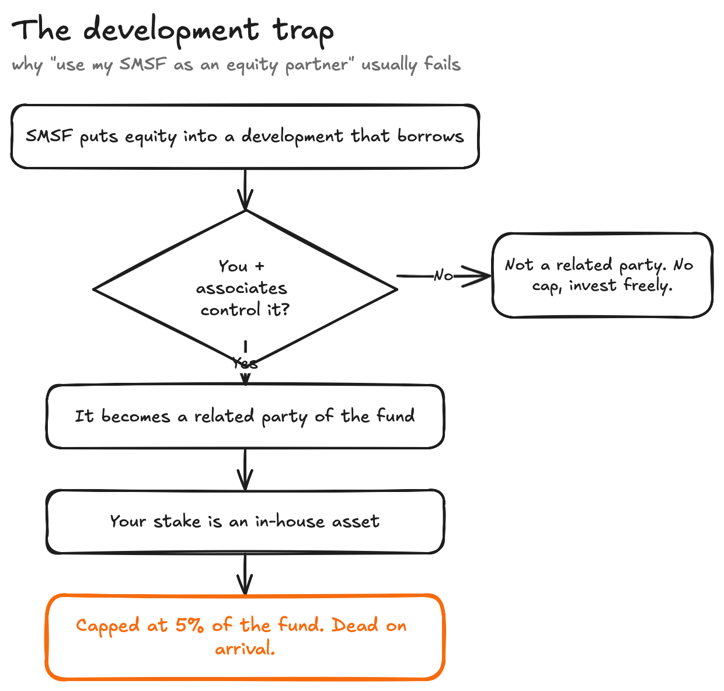
Development. The carousel version is "use your SMSF as an equity partner in a development." The trap is control, and it turns on two numbers that do two completely different jobs.
The first number is 50%. That is the control test. If your fund and your associates hold a fixed entitlement to more than 50% of the development vehicle, or can direct or appoint its trustee, the fund controls it, and a vehicle the fund controls is a related party of the fund.
What the law says · [Existing law] SIS Act 1993 s 70E(2), control of a trust
"an entity controls a trust if: (a) a group in relation to the entity has a fixed entitlement to more than 50% of the capital or income of the trust; or (b) the trustee... is accustomed or under an obligation... to act in accordance with the directions... of a group...; or (c) a group... is able to remove or appoint the trustee, or a majority of the trustees, of the trust."
The second number is 5%, and it comes from a separate rule, the in-house asset cap in Part 8 of the SIS Act. A fund's investment in a related party is an in-house asset, and in-house assets can never be more than 5% of the fund's total value.
Now chain the two together. Control the geared development vehicle, and it becomes a related party, which makes your stake in it an in-house asset, which caps that stake at 5% of the fund. Five per cent is nowhere near enough to fund a real development position, so the controlled version is dead on arrival. The play only works the other way around: stay under 50% and non-controlling, as a genuine minority alongside unrelated parties. Then the vehicle is not a related party, the 5% cap never applies, and the fund can actually invest. A 13.22C trust also escapes in-house treatment, but it cannot borrow, so a geared development vehicle cannot use that door either.
That is the opposite of "use my super to fund my own project." Most people who ask about it want the controlled version, which is exactly the version that does not work. Add the ATO's standing focus on development arrangements, where profits above the fund's real contribution are treated as NALI, and this is a structure for a specific situation with specialist advice, not a general move.
The 13.22C trust again. Worth restating as a trap, not just a structure. Its power, holding a related trust's units outside the in-house rules, depends on continuous, perfect compliance with every condition. The most common way people lose it is the most ordinary: the trust borrows a little, or takes a charge, or buys an asset from a related party that is not business premises. One slip, and 13.22D applies.
8. Two worked examples
Numbers make the trade-offs concrete. These are illustrative, rounded, and meant to show the shape of the choice, not to model your fund.
Example 1: the same $500k, three cash routes
A fund has $500,000 to deploy and does not want to borrow.
- Route A, residential, direct. Buys a $500,000 house outright, leased to a tenant for around $25,000 gross, maybe $20,000 net. Tax on that net at 15% is about $3,000. Growth is taxed at roughly 10% on sale. The cost: the entire fund now sits in one residential asset, in one suburb, with no liquidity and no leverage.
- Route B, commercial, direct. Buys a $500,000 commercial unit, leased to a business tenant for around $35,000 gross. Higher rental income, same 15% and roughly 10% tax treatment, but longer vacancies when a tenant leaves and a lumpier asset to re-let.
- Route C, pooled via 13.22C. Puts the $500,000 alongside $300,000 from the family trust into an ungeared unit trust, which buys an $800,000 property. The fund owns 62.5% of the units. Better asset, shared concentration, no borrowing. The price is the compliance load and the 13.22D cliff sitting over the whole arrangement for as long as it exists.
None of the three uses leverage, because none can. That is the post-ban reality for residential and for unborrowed commercial alike: in cash, the fund buys what it can afford and accepts the concentration.
Example 2: the surviving leverage
The same fund, but it wants to gear.
- Commercial via LRBA. Puts the $500,000 in as a deposit, borrows $700,000 under a limited recourse loan, and buys a $1.2 million commercial property leased to a business. Now the rental income and the growth work on $1.2 million of asset, not $500,000. The fund carries the loan and the compliance, and the lender can only ever reach that one property.
- The same move in residential is simply gone. Before commencement it was the most common SMSF property strategy in the country. After commencement it does not exist for new arrangements.
That contrast is the entire change in one comparison. Leverage in super now means commercial.
9. A decision tree
If you strip the topic to its logic, it is four questions.
- Do you need to borrow? If yes, you are buying commercial. Business real property under an LRBA is the only geared path left. If no, go to question 2.
- Commercial or residential? Commercial: buy outright, and lease to your own business or to a tenant, both fine at market rent. Residential: go to question 3.
- Can the fund afford the property on its own? If yes, buy it directly, from an unrelated seller, leased to an unrelated tenant. If no, pool through a 13.22C ungeared trust, and accept the compliance cliff.
- Do you want hands-off and liquid instead? Then a listed REIT or a genuinely widely held fund, residential or commercial, at any balance.
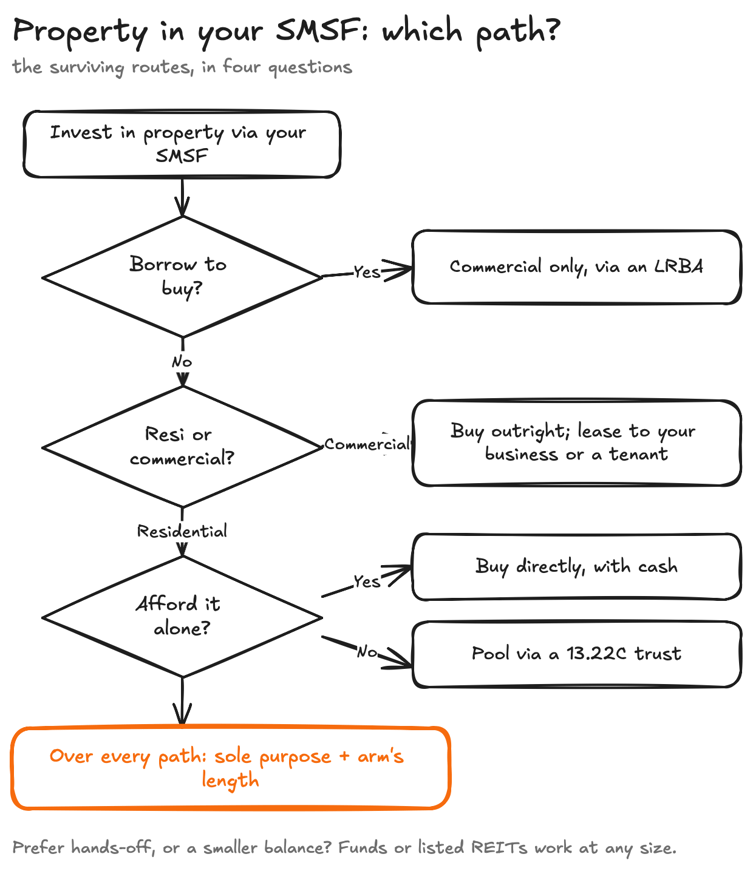
Over all four questions, two gates never move: the fund is maintained solely for retirement benefits, and every dealing is at arm's length. Fail either and the structure does not matter, because the tax outcome is 45% and the regulator is interested.
10. Sam works it out
Sam is 44. He holds three properties in his own name, the original Brisbane house, a regional duplex, and a Hunter Valley dual-income, and he and his wife run a self-managed fund with about $500,000 in it. When the borrowing ban hit the news, his first reaction was the common one. He had been turning over the idea of using the fund to buy a residential property with a loan, the way a colleague did three years ago. That idea is now off the table, and for a day he assumed the whole question was closed.
It is not closed, it is reshaped. So he works the tree.
He does not own a business, so the strongest commercial play, leasing premises to his own company, is not his. That rules out the marquee structure, but not commercial itself. He can still buy a commercial property and lease it to an arm's length tenant, and his super keeps the one-third CGT discount his personal portfolio is about to lose. That alone makes the fund the more tax-efficient place to hold growth now, not the less.
Residential he rules out quickly. Cash-only, his $500,000 would buy one modest house outright and put the whole of his and his wife's super into a single undiversified asset. He has three houses already in his own name. He does not need a fourth, unborrowed, sitting inside his retirement savings.
So it comes down to commercial, and to the question he did not expect to be the hard one. Buy a property outright with the $500,000, or gear into something larger.
Outright is clean. He owns a roughly $500,000 commercial property with no debt, the rent lands at 15%, and there is nothing to service. Gearing is the bigger move. A deposit plus a limited recourse loan could put him into a property closer to $1 million, with the growth and the rental income working on twice the asset base, inside the same tax wrapper.
His instinct is caution, because he is already geared to the limit in his own name. But he makes himself look at it properly, and two things change his mind. First, the LRBA is limited recourse and sits entirely inside the fund. It does not touch his personal borrowing capacity or his personal assets, so it is not adding to the gearing already stretched in his own name. It is a separate, contained risk. Second, the risk he was picturing, a sharp fall in value, is not really the risk that matters for a well-chosen commercial property leased to a solid tenant. Those tend to hold their value and climb higher over time. The risk that actually bites is a vacancy, a quarter or two with no rent and a loan that still has to be paid.
That reframes the decision. The danger is not the asset, it is running out of cash to carry it through a gap. So Sam gears, but he refuses to gear to the hilt. Rather than tip the entire $500,000 in as deposit, he keeps about $75,000 back as a working-capital buffer in the fund. He puts the remaining $425,000 toward a roughly $1 million commercial property leased to an established tenant, with a limited recourse loan of around $650,000. The rent covers most of the interest, his and his wife's contributions cover the rest and chip at the principal, and the buffer is there to carry the loan through a vacancy without ever forcing a sale at the wrong moment.
That is the actual discipline, and it is not "avoid debt." It is "do not use all of it." A younger investor with a longer runway might gear harder. Someone near retirement might not gear at all. Sam sits in between, so he takes the larger asset and the larger growth, and he buys himself room to be wrong about timing. "Can I" and "should I" are different questions. The law answered the first one. The buffer is how he answers the second.
11. The thing to hold onto
I read a lot of confident commentary while writing this, and most of it was answering the wrong question. The law did not close property in super. It closed one financing method for one asset type, and it left the rest, including super's tax advantages, sitting exactly where they were, now relatively more valuable than before.
The map has not shrunk as much as the noise suggests. What it demands is that you know which question you are answering, the buying strategy or the related-party dealing, and that you match the structure to your own situation rather than to a diagram someone drew to get attention. The structures are not the strategy. You are. Read the rules, get specialist advice on your own numbers, and decide deliberately.
See you next week.
-Alex Zarate
If this was useful, forward it to someone who has been told the super property door is closed. And if you are not subscribed yet, you can join the list at pbco.com.au.
References and sources
Every legal quote in this edition is taken directly from the primary text. The links below let you read the same words I did.
The new law
- Treasury Laws Amendment (Tax Reform No. 1) Act 2026, Parliament of Australia (Schedule 5 amends SIS Act s 67A; Schedule 2 inserts ITAA 1997 s 26-155; Schedule 1 amends the CGT discount at ITAA 1997 s 115-100): aph.gov.au, Bill r7493
- Prime Minister of Australia, "Government another step closer to delivering tax reforms" (23 June 2026): pm.gov.au
Superannuation Industry (Supervision) Act 1993
- s 62, Sole purpose test: austlii.edu.au
- s 66, Acquisitions from related parties, and the definition of business real property at s 66(5): austlii.edu.au
- s 67A, Limited recourse borrowing arrangements: austlii.edu.au
- s 70E, Meaning of control: austlii.edu.au
- s 71, In-house assets, including s 71(1)(g) and the widely held unit trust test at s 71(1A): austlii.edu.au
Superannuation Industry (Supervision) Regulations 1994
- reg 13.22C, Non-geared unit trusts: austlii.edu.au
- reg 13.22D, When the exemption ceases to apply: austlii.edu.au
Income Tax Assessment Act 1997
- s 295-550, Meaning of non-arm's length income: austlii.edu.au
- s 115-100, CGT discount percentage: austlii.edu.au
For the definitive in-force versions, the Federal Register of Legislation (legislation.gov.au) holds the current compilations of each Act and the Regulations.
Australian Taxation Office guidance
- "What are the SMSF investment restrictions?": ato.gov.au
- SMSF Regulator's Bulletin SMSFRB 2020/1, SMSFs and property development: ato.gov.au
- SMSFR 2009/1, Self Managed Superannuation Funds Ruling on the meaning of business real property: ato.gov.au/law
- SMSFR 2012/1, SMSFs and limited recourse borrowing arrangements: ato.gov.au/law
- Taxpayer Alert TA 2023/2, Diverting profits of a property development project to an SMSF through use of a special purpose vehicle: ato.gov.au/law
- Moneysmart (ASIC), "SMSFs and property": moneysmart.gov.au
Specialist commentary (used to cross-check the reading)
- DBA Lawyers, "SMSFs investing via unit trusts": dbalawyers.com.au
- SMSF Adviser, "Leasing property owned by an SMSF": smsfadviser.com
- Grow SMSF, "Renting a commercial property owned by your SMSF": growsmsf.com.au
- SMSF Adviser, "Super, SMSFs excluded from CGT changes": smsfadviser.com
This article is for educational purposes only. It does not constitute financial, legal, or tax advice. Everyone's circumstances are different. SMSF rules are technical and the consequences of error are significant. Please seek professional advice from your own SMSF specialist, accountant, and lawyer before acting on any of the strategies outlined above.