.png?width=165&height=66&name=Untitled%20design%20(9).png "Untitled design (9)")

The federal budget didn't just shift the tax math. It changed which order you buy in.
Here's a trap that's easy to miss until you're already in it.
Three properties, all reasonable assets, all bought in the same market cycle. And you're done. Not because you ran out of ambition. Because the annual cash drain from the wrong sequence quietly consumed your borrowing capacity. The portfolio stops growing not with a crisis, but with a quiet conversation at the bank where the answer is: not at this time.
Under the old rules, this trap was rarer. The tax system subsidised the carry on negatively geared assets. The annual offset against salary softened the cashflow hit. You could sequence purchases in almost any order and the cost of a poor choice would take years to fully show up.
That window has closed.
Issues #11 and #12 covered the mechanics of the federal budget changes: negative gearing on new established purchases is deferred from 1 July 2027, and the 50 percent CGT discount is being replaced by cost base indexation plus a 30 percent minimum tax on real gains from the same date. Those two issues focused on the direct financial impact. This one covers the second-order effect most commentary has skipped: the sequence in which you buy now determines whether you can keep buying at all.
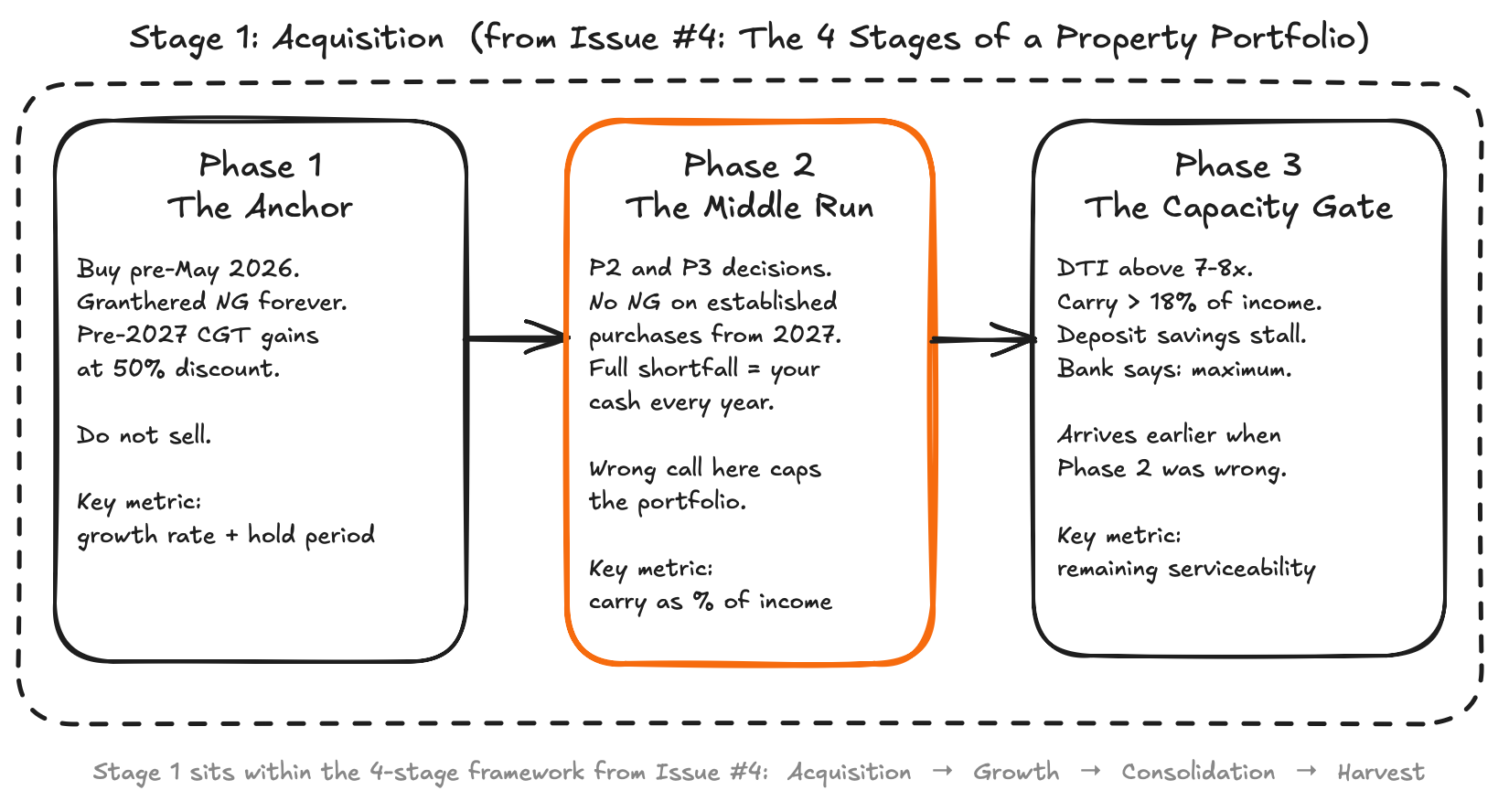
The reference point is Issue #4, which mapped the four stages of portfolio construction. This edition zooms into Stage 1 — Acquisition — and maps the three phases within it that determine whether you arrive at Stage 2 with genuine momentum or get stuck at two properties wondering what happened.
Phase 1: The Anchor
The best version of this phase has already passed for most readers.
A property acquired before 12 May 2026 is grandfathered on negative gearing permanently. Losses continue to offset against salary for as long as you hold the asset. On the CGT side, gains accrued before 1 July 2027 are still calculated under the 50 percent discount. Buy early, hold long, and a greater share of the lifetime gain falls under the old regime. The longer you held before May 2026, the more the compounding has run, and the more of the eventual gain sits in the grandfathered portion.
If you already own a property from before the announcement, that asset is doing something no future purchase can replicate. It is carrying a tax treatment that no longer exists for new purchases. The sequencing rule for Phase 1 is therefore straightforward: do not sell it. Whatever pressure comes from rates, cashflow, or short-term costs, the grandfathered position is permanent. Surrendering it to release capital is a decision you cannot reverse.
Key insight: The asset bought before May 2026 is the anchor of any serious accumulation strategy. Future properties will be built around it, not in place of it.
Phase 2: The Middle Run
This is where the sequence problem lives. Purchases two and three in your portfolio are now made under fundamentally different conditions, and the cashflow profile of each one directly determines whether you can make the next.
Under the old rules, you could acquire another low-yield, high-growth residential asset and absorb the carry as a manageable annual cost. The deduction against salary reduced the effective hit. A shortfall of $18,000 became a real cost of around $11,000 after the offset. You had tax-system support for the decision.
From 1 July 2027, that support is gone on new established purchases. The shortfall is the shortfall. No annual offset against salary. The full cost comes out of your account every year until you sell, at which point the accumulated carry-forward losses offset part of the gain.
That changes the sequencing logic entirely. Two properties with similar purchase prices can produce dramatically different annual carry depending on their yield profiles, and that difference now falls entirely on you. It no longer gets softened by the tax system.
The shortfall is not an accounting entry. It is money out of your account, every month. And it compounds into your borrowing capacity: every additional dollar of annual carry reduces what a bank will assess you can afford on the next loan.
There are now three things a purchase in Phase 2 needs to pass, in this order:
- Cashflow test first. Can you fund the full annual shortfall without the offset, comfortably, without compressing your ability to save for the next deposit? If not, the investment logic is broken regardless of the growth case.
- DTI position. What does this purchase do to your total debt relative to income? A high-carry, high-loan purchase can push the ratio to a point where P3 becomes structurally inaccessible.
- Growth case last. The growth argument still matters. But it cannot paper over the first two. A strong growth asset that fails the cashflow and DTI tests is not a good P2 under the new rules.
The sequencing insight: the choice you make at P2 determines not just whether that asset performs, but whether you ever get to P4.
Key insight: The tax relief that used to make a low-yield purchase manageable no longer exists from 1 July 2027. Yield is now a sequencing variable, not just a return metric.
Phase 3: The Capacity Gate
Every investor in Stage 1 eventually reaches a gate. The gate is not a policy and it is not a rule. It is the point at which your total debt, annual carry, and serviceability position combine to tell the bank you are done.
Most investors who stop at two or three properties did not necessarily buy bad assets. They bought assets in an order that created a cumulative cashflow and DTI position the lending math could not accommodate further. The gate arrived early because the sequence was wrong.
The signs that the gate is close:
- Annual out-of-pocket carry has climbed past 15 to 18 percent of gross income
- Debt-to-income ratio is above 7 to 8 times
- Deposit accumulation has slowed because carry is absorbing the surplus
- Serviceability conversations are starting to include the word "maximum"
Under the new rules, the gate arrives sooner for investors who did not optimise Phase 2. Two poorly sequenced purchases, and the gate can appear a decade earlier than planned.
Key insight: The capacity gate is not about running out of equity. It is about running out of serviceability. The sequence in Phase 2 determines how early it appears.
Sam's Two Paths
Sam is 41. He owns one investment property: a three-bedroom house in a western corridor suburb, bought 18 months ago for $710,000, now worth approximately $760,000. The property is grandfathered on negative gearing. His effective after-tax carry is around $8,800 per year on a $150,000 gross income.
He is ready to buy again. He is considering two options.
Scenario A is an established property at $810,000. 80 percent LVR. Gross yield 3.0 percent. Purchased after 12 May 2026, which means no annual negative gearing deduction against salary from 1 July 2027 onwards.
Scenario B is a qualifying new build at $750,000. 80 percent LVR. Gross yield 4.0 percent. Retains full negative gearing concession as a supply-additive new build.
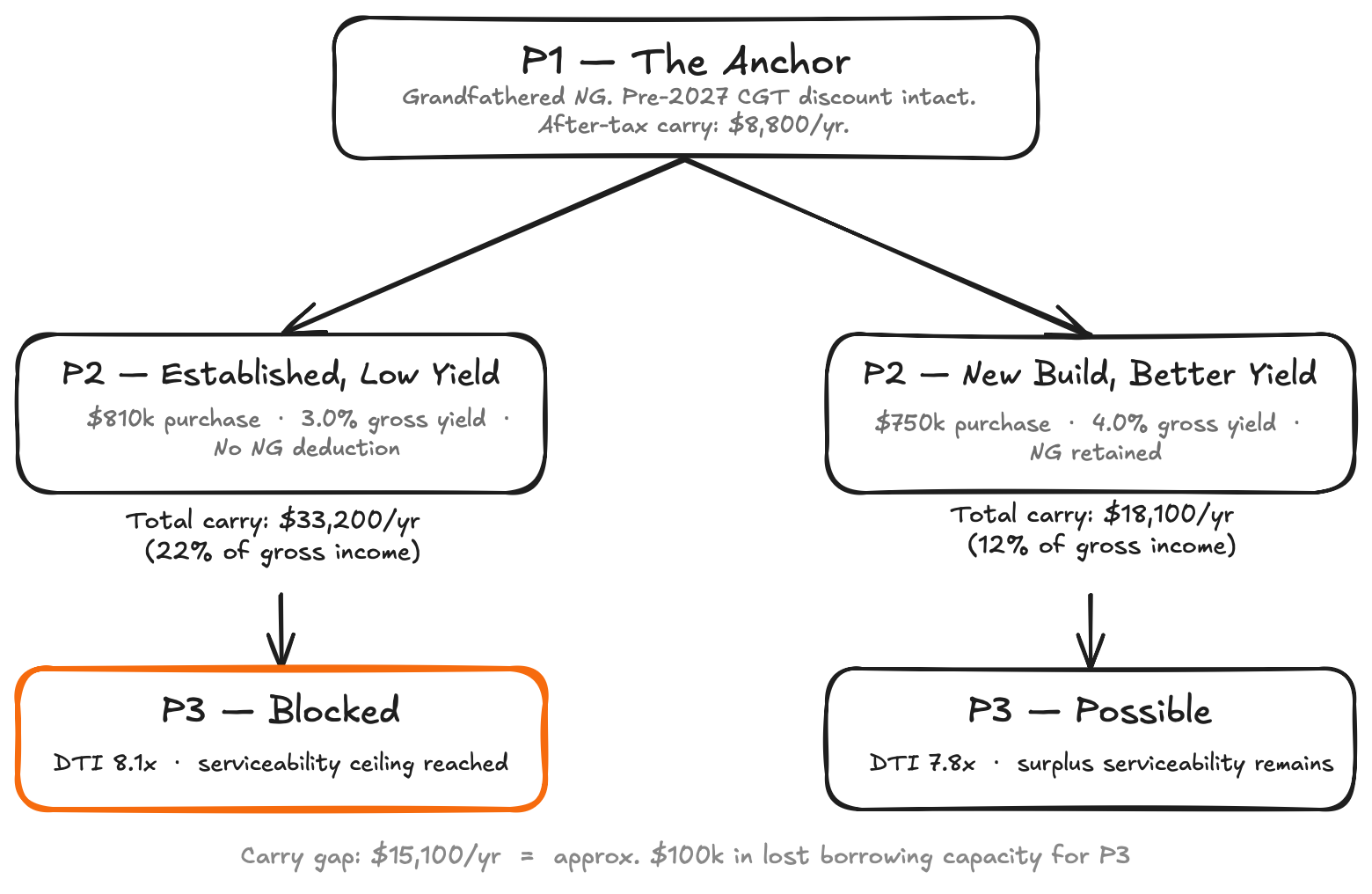
Here is how the portfolio looks after each path:
| Metric | P1 only | P1 + P2 Scenario A | P1 + P2 Scenario B |
|---|---|---|---|
| Combined property value | $760,000 | $1,570,000 | $1,510,000 |
| Total loan balance | $568,000 | $1,216,000 | $1,168,000 |
| Portfolio LVR | 75% | 77% | 77% |
| Annual shortfall (pre-tax) | $14,000 | $38,400 | $28,700 |
| NG deduction available | P1 yes (grandfathered) | P1 only | Both |
| Annual cash carry (after NG relief) | $8,800 | $33,200 | $18,100 |
| Carry as % of gross income | 6% | 22% | 12% |
| Debt-to-income ratio | 3.8x | 8.1x | 7.8x |
| Path to P3 | Blocked | Possible |
Illustrative figures. 6.2% IO rate, $150,000 gross income, 37% marginal rate, 3% holding costs.
The DTI numbers look similar. The carry numbers are not.
In Scenario A, Sam commits $33,200 per year in out-of-pocket property costs. That is $2,767 per month before he has paid for his own life. On $150,000 gross, take-home is roughly $9,400 per month. More than 29 percent of take-home is consumed by carry. There is almost nothing left to accumulate a deposit for P3. And the bank's serviceability assessment reflects the same arithmetic: each dollar of carry reduces available future borrowing.
In Scenario B, the carry is $18,100, or $1,508 per month. Still material. But there is enough surplus to continue saving and to pass the next serviceability test within 18 to 24 months.
The purchase prices are not that different. The yields are. And under the new rules, yield is the sequencing variable that determines whether Sam arrives at P3 or not.
Sam runs both paths to their logical conclusion. Scenario A leads to a portfolio worth $1.57M with no viable path to P3 for at least five years, if at all. Scenario B leaves a real path to P3 within two years, and to P4 within five.
He chooses the new build.
Reflection
The budget commentary has mostly focused on the raw disposal math: how much more or less an investor pays when they sell. That is worth understanding and Issues #11 and #12 covered it in detail.
What receives less attention is how the rule changes reshape the intermediate decisions — the ones made not at disposal, but during the years of building a portfolio. Sequence has always mattered. Under the old rules, the tax system had enough give in it to absorb a poor sequence decision and let you recover. Under the new rules, there is less give. A wrong call at P2 does not just hurt P2. It caps the portfolio.
Most investors who build strong portfolios do not necessarily buy the best individual assets. They maintain the ability to keep buying. They arrive at each new purchase decision without their position having already been consumed by the previous one. Getting the sequence right in the first three acquisitions is the thing that keeps future choices available.
The goal is not to own three great properties. It is to still be able to buy the fourth.
If this was useful, share it with someone who is trying to figure out the same thing. And if you are not subscribed yet, join the list at pbco.com.au.
See you next week. — Alex
Next week: High Income, No Momentum — why a strong salary does not automatically translate into a growing property portfolio.
This article is for educational purposes only. It does not constitute financial, legal, or tax advice. Everyone's circumstances are different. Please seek professional advice before acting on any of the strategies outlined above.