.png?width=165&height=66&name=Untitled%20design%20(9).png "Untitled design (9)")

They are not two camps you belong to. They are two levers on the same asset, and which one you pull depends on where you are, not who you are.
Ask an investor whether they are a yield buyer or a growth buyer and most will answer instantly. It is one of the few questions in property that gets a faster answer than "what do you need to retire." People say it the way they say what football team they follow.
That confidence is the problem. Yield and growth are not tribes and they are not opposites. They are two properties of the same asset, and the useful question is never which one you prefer. It is which one your portfolio needs to be doing more of, right now, given how far along you are.
Get the sequencing right and the two stop competing. Get it wrong and you can spend fifteen disciplined years building something that is worth a great deal and pays you nothing.
First, what each one actually does
Growth is the increase in the asset's value. It compounds, it is untaxed until you sell, and it is the only lever that meaningfully changes your net worth over a decade. It is also completely unspendable until you either sell or borrow against it.
Yield is what the asset pays you while you hold it. Rent, net of rates, insurance, management and maintenance. It is spendable, it is taxed as it arrives, and it barely moves your net worth at all.
So they answer different questions.
- Growth answers: how large does this position become?
- Yield answers: can I afford to keep holding it, and eventually, can I live on it?
Notice that the second question has two halves, and almost everyone only hears the retirement half.
Key insight: in the years before retirement, yield is not a return target. It is a serviceability input. It is the thing that lets you keep the growth asset.
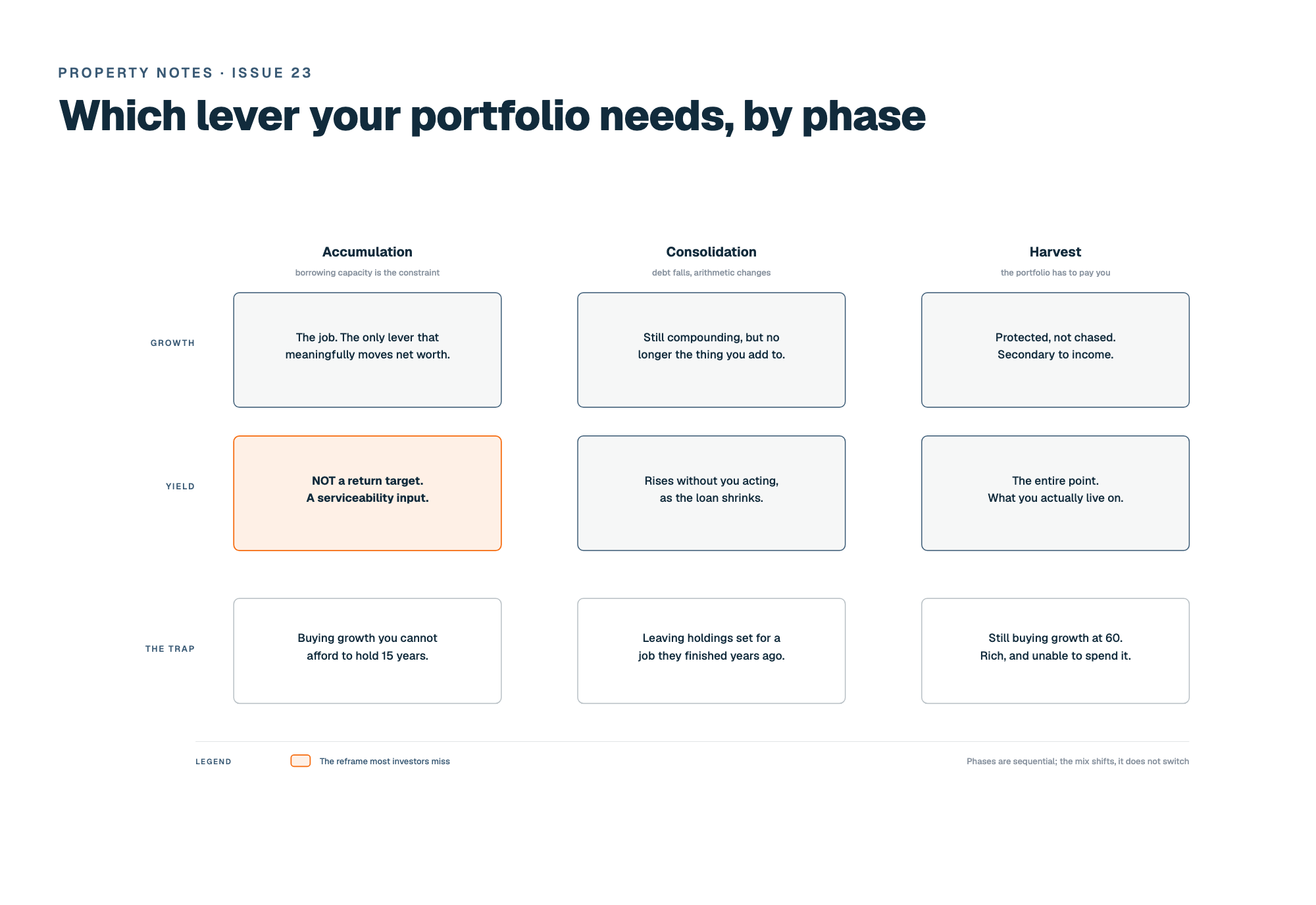
That reframing is most of the work. Once yield is understood as what buys you holding power, the "which one are you" question stops making sense.
Phase 1: Accumulation, where growth does the work
Early on, your borrowing capacity is the binding constraint, not your deposit. That was the subject of the last edition, and it applies directly here.
In this phase growth is what you are buying and yield is what makes the purchase survivable. A property with a very thin rental return consumes serviceability you will need for the next acquisition. A property with a stronger return supports the next one.
So the yield question in accumulation is not "how much income does this produce." It is "how much of my capacity does this hand back to me."
Key insight: the highest-growth asset you cannot afford to hold for fifteen years is worse than the moderate one you can.
Phase 2: Consolidation, where the mix quietly rebalances
At some point the acquiring stops, either by choice or because capacity runs out. Debt starts falling. Rents keep drifting up.
Nothing about the assets changes, but the arithmetic does. The same portfolio that netted nothing at seventy percent debt starts producing real surplus at forty. Investors often read that as the market improving. Usually it is just the debt shrinking.
This is the phase where most portfolios are quietly mis-set. The holdings were chosen for a job they finished years ago, and nobody re-examined them.
Key insight: consolidation is not a waiting room. It is when you decide which assets carry you into the next phase.
Phase 3: Harvest, where yield is the entire point
Eventually the portfolio has to pay you. Growth stops being the objective and becomes something you preserve rather than chase.
This is where the false choice does its real damage, because an investor who has spent twenty years identifying as a growth buyer often keeps buying growth into their sixties. The portfolio is worth a fortune. The income is thin. And the only route to spending any of it is to sell, which is the one move the whole plan was designed to avoid.
Key insight: you cannot harvest a portfolio you built to never harvest.
What the tax reform does to this
Worth stating plainly, because it changes the balance between the two levers for the first time in a generation.
From 1 July 2027 the fifty percent capital gains discount comes off established residential investment property, replaced by cost-base indexation with a thirty percent minimum rate. Rental income tax treatment is unchanged.
Read that again as a comparison. The growth lever is being taxed harder. The income lever is not.
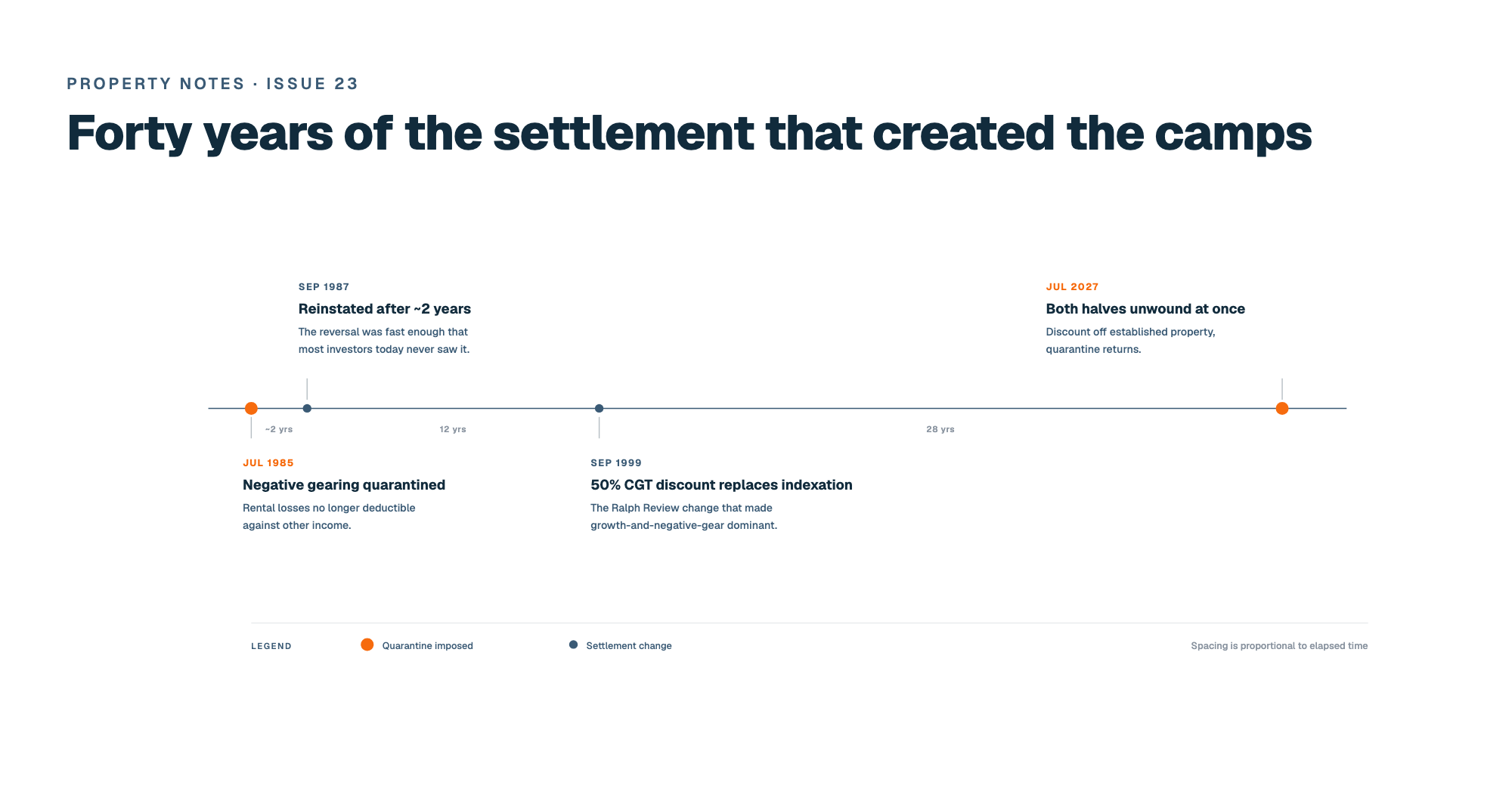
That does not make growth a bad idea, and it certainly does not make this a reason to rush a decision. Growth is still the only lever that meaningfully builds the asset base. But the after-tax gap between the two has narrowed, and any plan whose harvest step was "sell one down the track and bank the discounted gain" is now working off arithmetic that expires.
There is also a mechanical date worth knowing: every asset is treated as sold at market value just before 1 July 2027 and reacquired, so gains accrued to that point keep their existing treatment. That is an administrative fact, not a prompt. Some definitions in the new rules are still to be confirmed by regulation.
Sam and the portfolio that pays nothing
Sam is 54 now, eight years on from the position we looked at in Issue 19. Two properties, held throughout, no additions. (Illustrative numbers.)
They are worth about 2.9 million against 950,000 of debt. Gross rent is around 104,000. After interest, rates, insurance, management and maintenance, the portfolio clears a little over twenty thousand a year. Better than the roughly zero it produced at 46, and nowhere near the 120,000 he wants at 60.
Here is what he notices when he stops asking which camp he is in. Almost all of the improvement since 46 came from debt falling, not from anything he did. The assets have been on autopilot doing the job he chose for them in his thirties, which was to grow. They are still doing it. Nobody ever told them to start paying him.
Six years out, his options are not "yield or growth." They are questions of sequence. Keep directing surplus at debt and let the same two assets produce more as the loans shrink. Or convert part of the position into something built to pay from day one, accepting slower growth on that slice. Or some deliberate combination, decided now rather than discovered at 60.
He has not settled it yet, and he does not need to this month. What changed is that he is now asking a question with an answer, instead of one about identity.
A note from me
The camps exist because they are useful shorthand for beginners, and then people forget to put the shorthand down. I have never seen a good portfolio that was purely one or the other, and I have seen plenty of expensive ones built by someone defending a label they picked up early and never revisited.
The asset does not know what you call yourself. It grows at whatever rate the market gives it and pays whatever the tenant pays, and your job is to decide, repeatedly, which of those two things your plan currently needs more of. That decision has a different right answer at 35, at 50, and at 62.
If you cannot say which phase you are in, that is the thing to work out first. Everything else downstream is guesswork until you can.
See you next week. — Alex
Want to see which phase your portfolio is actually in? The Property Portfolio Gap Analysis walks through where you are, where you are going, and the distance between them. About five minutes, at pbco.com.au.
This article is for educational purposes only. It does not constitute financial, legal, or tax advice. Everyone's circumstances are different. Please seek professional advice before acting on any of the strategies outlined above.