.png?width=165&height=66&name=Untitled%20design%20(9).png "Untitled design (9)")

It is the largest asset most people own and the one doing the least work. The cost is not the house. It is what the house absorbs.
Ask most people what their best investment has been and they will tell you about their home. They bought it for four hundred thousand, it is worth 1.3 million now, and the arithmetic looks unanswerable. It is a fair answer to the wrong question. A house that triples in value while producing nothing you can spend is not a bad asset to own. It is simply not an investment, and treating it as one is the most expensive category error in Australian property.
This edition is not an argument against owning a home. It is an argument for measuring what the home is actually doing, and for keeping the home decision and the portfolio decision in separate columns. Most people run them as one, which is how a household ends up asset rich, portfolio poor, and genuinely confused about why.
FIRST, WHAT AN INVESTMENT ACTUALLY IS
Strip the sentiment out and an investment does three things. It produces income you can spend. It can be sold in parts. It compounds independently of how you live.
The family home does none of the three.
- It pays no rent. The growth is real, but it is unbanked until you sell.
- It cannot be divided. You cannot sell the spare bedroom to fund a bad year.
- Its growth is trapped. Sell into a rising market and you buy back into that same market at the same inflated prices, which is why the profit so often disappears the moment you try to use it.
The home does produce something. It produces shelter, stability, and a place to raise a family, which is worth paying for and does not need a financial justification bolted onto it.
Key insight: the growth in your home is real and largely inaccessible. Both things are true at once.
Once you accept that, three specific absorptions come into view. They are what the home actually costs, and none of them appear on a bank statement.
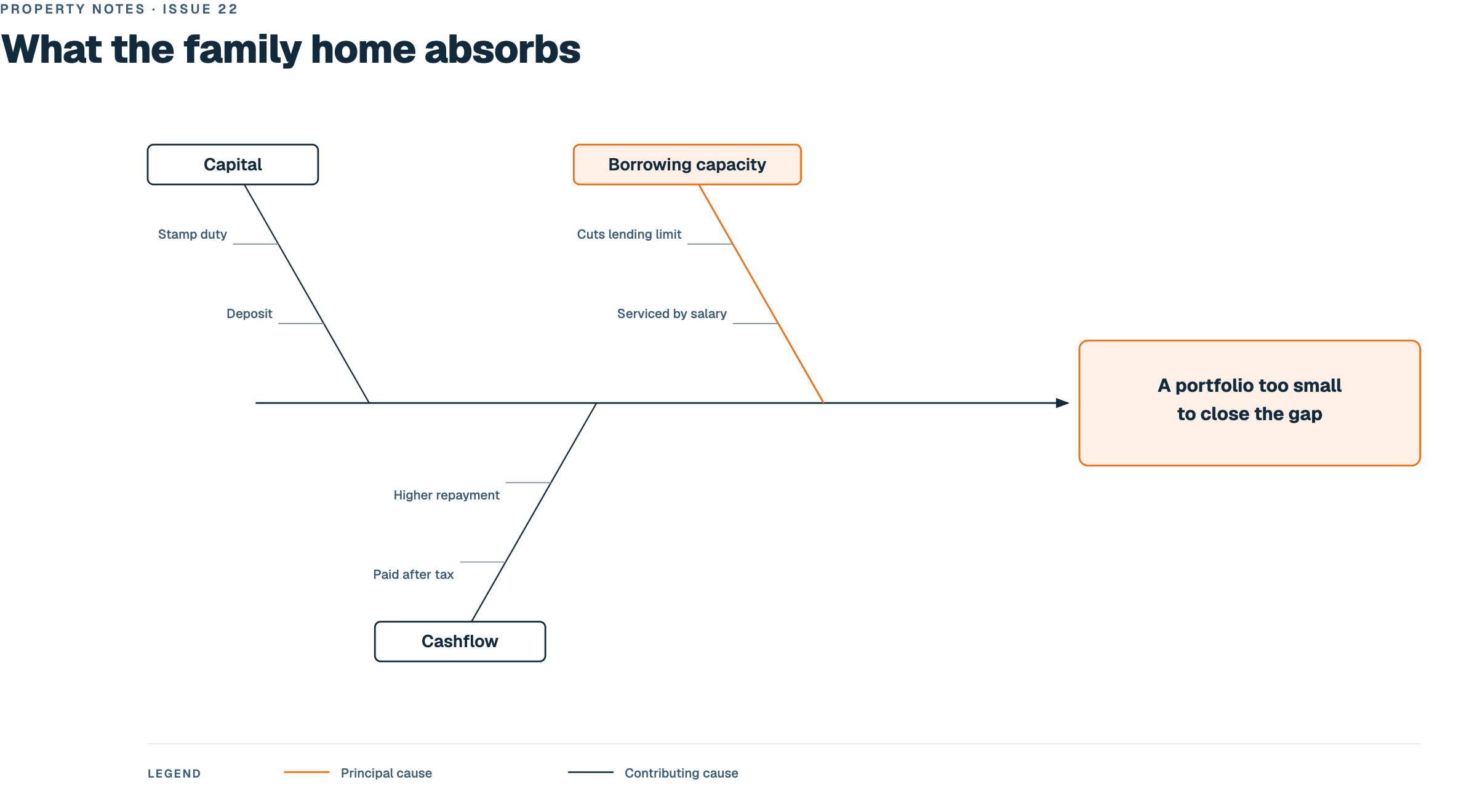
ABSORPTION #1: THE CAPITAL THAT STOPS WORKING
Every dollar that goes into the home is a dollar that is no longer available to compound. The deposit. The stamp duty. The renovation that was going to add value and returned about sixty cents in the dollar.
Stamp duty is the cleanest example because it is unambiguous. It is tens of thousands of dollars that vanish on settlement and appear nowhere in the asset. Nobody counts it. It is the single largest cost most households pay without ever writing it down.
Key insight: the home is not just a place capital sits. It is a place capital stops.
ABSORPTION #2: THE BORROWING CAPACITY YOU CANNOT SEE
This is the one that actually costs people a portfolio, and almost nobody measures it.
An owner-occupier mortgage is serviced entirely out of your salary. An investment mortgage is serviced partly by a tenant. To a lender assessing what you can carry, those two debts are not equivalent, and every dollar committed to the home reduces what they will extend against an income-producing asset.
So the trade is not "bigger house now, investment later." The trade is bigger house now, and a materially smaller portfolio available to you for the following decade, at exactly the age when a longer runway does the most work.
Key insight: the home does not only consume capital. It consumes the capacity to acquire, which is the scarcer of the two.
ABSORPTION #3: THE CASHFLOW THAT NEVER COMPOUNDS
The last absorption is the monthly one. The difference between the home you have and the home you were considering is not a lifestyle rounding error. It is the engine.
An extra six hundred thousand of owner-occupier debt costs roughly four thousand a month to service. That money leaves after tax, buys no income, and cannot be recovered. Directed instead at an asset that a tenant part-services, the same figure carries a substantially larger position.
Key insight: the upgrade is not paid for out of the price difference. It is paid for out of the compounding you were going to do.
THE HONEST COUNTER
There is a real argument on the other side and it has just become stronger, so it deserves stating properly rather than being written around.
From 1 July 2027 the 50 percent capital gains discount no longer applies to established residential investment property. It is replaced by cost-base indexation, which shelters inflation but not real growth, and a 30 percent minimum rate. Separately, rental losses on established dwellings acquired after 12 May 2026 are quarantined rather than deductible against salary. The main residence exemption was not touched.
Read plainly, that means the tax system just widened the gap in the home's favour. An investment property is taxed harder than it was; the home remains exempt on exit. Anyone arguing the home is a poor asset purely on tax grounds is now arguing against the legislation.
The concession does not rescue the claim, though. A tax exemption on an asset that produces no income is a discount on one bill, at the end, and only if you sell and leave the market. It improves the exit. It does not make the home produce anything in the thirty years before that. What the reform genuinely changes is the balance of the decision, and it deserves to be run properly rather than assumed in either direction. (Some definitions in the new rules, including what counts as a new dwelling, are still to be confirmed by regulation.)
SAM AND THE UPGRADE
Sam is 44 here, a couple of years before the portfolio position we walked through in Issue 19. He and his wife have outgrown the house. There is a place across the suburb at 1.9 million that would solve every complaint they have. (Illustrative numbers throughout.)
Their current home is worth 1.35 million with 520,000 owing. The upgrade adds 550,000 to the price. Selling costs, stamp duty and legals come to roughly 115,000, none of which shows up in the new house's value. The mortgage goes from 520,000 to about 1.19 million.
Sam prices the increase properly for the first time. The extra 665,000 of home loan costs him around 48,000 a year to service, out of after-tax salary, producing nothing he can spend.
Then he prices the other use of the same capacity. Releasing 180,000 of equity would cover the deposit and costs on a 750,000 investment property. The loan on it runs about 36,000 a year in interest; rent net of rates, insurance, management and maintenance covers most of that. Combined with the interest on the released equity, his actual out-of-pocket sits near 21,000 a year, and he notes that buying established stock now means any rental loss is quarantined rather than offset against his salary, which he factors in rather than discovering later.
Two paths. One costs 48,000 a year and produces a better kitchen. The other costs about 21,000 a year and produces an asset with a tenant attached.
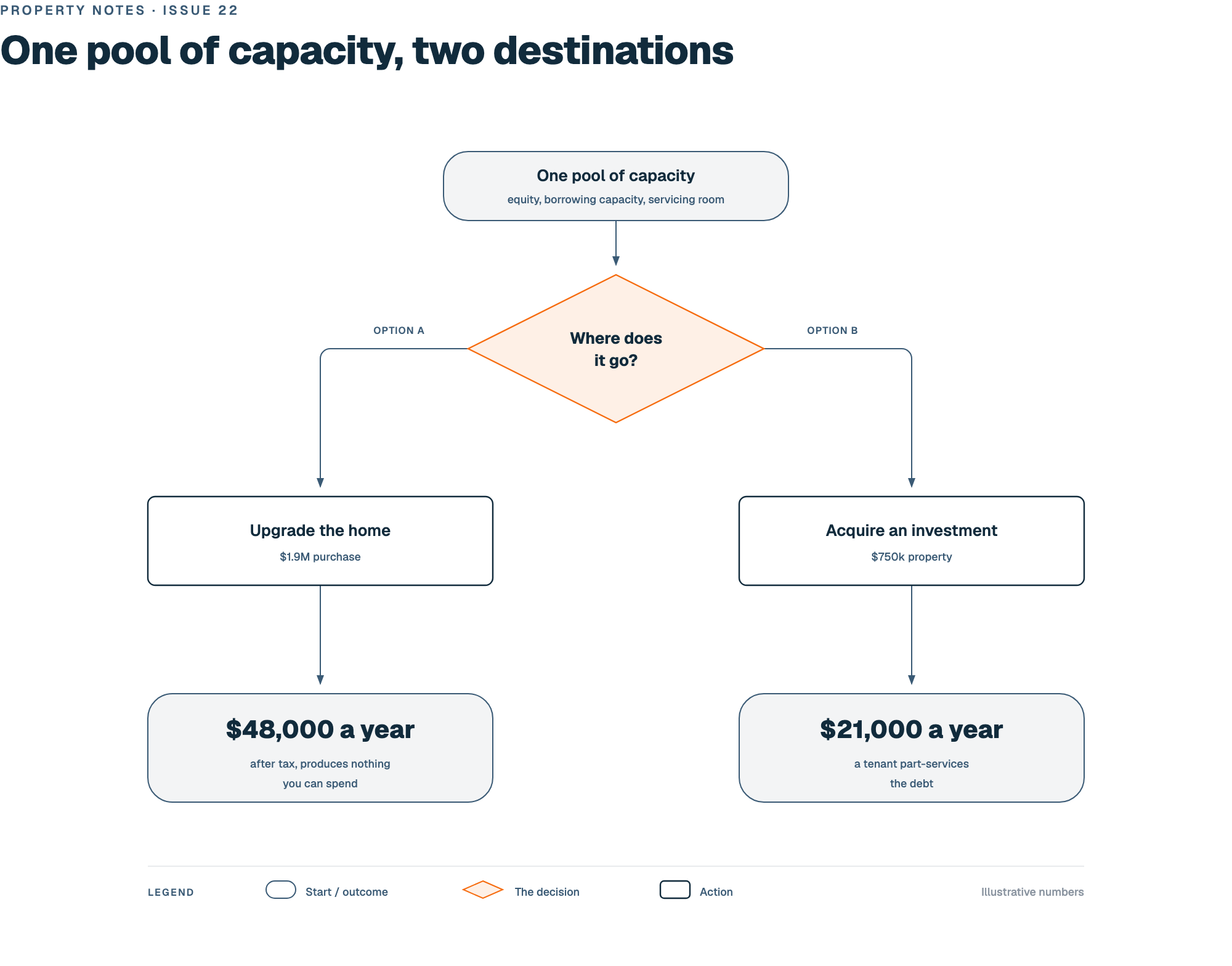
Sam did not conclude that upgrading was wrong. He concluded that it cost 27,000 a year more than he had assumed, and that the true price was a property he would now not own. He and his wife chose to stay another four years and did the renovation instead. That was a decision about their life, made with the number in front of them, which is the only version of that decision worth making.
A NOTE FROM ME
I have never met anyone who regretted buying a home. I have met plenty who quietly regretted how much of it they bought, and almost none of them made that call with the second number in view. The mistake is rarely the house. It is running one balance sheet where there should be two, so the lifestyle decision silently eats the capital that was meant to build the portfolio, and nobody notices until the borrowing capacity is gone. You are allowed to spend money on where you live. Stewardship is not austerity. But name it as a lifestyle decision, price it honestly, and make it on purpose. A home bought with clear eyes is a fine thing to own. A home bought with the portfolio's money, by accident, is the most common way serious people end up behind.
See you next week. — Alex
Want to see what your current position actually supports? The Property Portfolio Gap Analysis walks through where you are, where you are going, and the distance between them, in about five minutes. Find it at pbco.com.au.